• Link to LinkedIn
  • Link to Youtube
  • Link to Instagram
  • English English English en
  • Italiano Italiano Italian it
  • Español Español Spanish es
T. +39.0523.891629        info@plp-systems.com        ITA | ENG | ESP       
PLP Systems
  • HOME
  • COMPANY
    • COMPANY PROFILE
    • WORK WITH US
  • SECTORS
    • ANIMAL FEED AND MILLING
    • PET FOOD
    • AQUA FEED
    • ENOLOGY
    • FOOD AND BEVERAGE
    • FERTILIZERS AND SEEDS
    • CHEMICALS AND COSMETICS
  • SYSTEMS AND MACHINERY
    • LIQUIDS
      • BATCH DOSING
      • CONTINUOUS DOSING
      • MIXING
      • SPRAYERS
      • COATING
    • POWDERS
      • BATCH DOSING
      • CONTINUOUS DOSING
      • MIXING
      • SPRAYERS
      • COATING
  • ONLINE EXHIBITION
  • PLP WORLDWIDE
  • NEWS
  • CONTACTS
  • Click to open the search input field Click to open the search input field Search
  • Menu Menu

NEWS

Home / News

Continuous muesli feed plant: PLP’s solution for ruminant nutrition

When it comes to ruminant nutrition, feed quality doesn’t depend on ingredients alone, it depends on how those ingredients are processed and combined. PLP Systems designs and supplies continuous muesli feed plants engineered to unite grain conditioning, soft rolling, multi-component dosing and liquid coating in a single, uninterrupted process. The result is a more digestible, more palatable feed produced with maximum operational efficiency.

In this article, we walk through how the plant works, phase by phase, and the concrete benefits it offers to livestock farmers and feed mills moving from batch production to a continuous, high-throughput process.

What is a continuous muesli feed plant

A continuous muesli feed plant is a production line that integrates, in constant flow, the processing of solid raw materials (cereals, protein seeds, pellets, mash, expanded products) with the dosed addition of liquids such as water, acid solutions, vegetable oils and molasses. Unlike batch production, the continuous process eliminates stops between cycles, ensuring greater product homogeneity and higher throughput.

How it works: the process phases

Phase 1: Standard plant production

The main plant standard production includes:

  • Corse grinding, mixing and sanitizing, to generate mash feed. The product is then stock in silos.
  • Standard grinding, mixing and palletization for compound feed and minerals. The product is then stock in silos.
  • Grinding, mixing and expanded feed. The product is then stock in silos..

Phase 2: Acid-water conditioning

This critical phase transforms dry grains (typically 12-14% moisture) into controlled, high-moisture ingredients.
This application is done in continuous by our mixer MT30SC, dosing the correct quantity of grains/seeds and proportionally dosing, spraying and mixing the liquid solution. Each type of grains are treaded separately and stored in dedicate silos overtime.

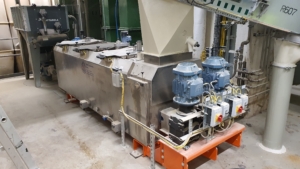
Acid-water conditioning with PLP continuous mixer MT30SC

Acid-water conditioning with PLP continuous mixer MT30SC

  • Added water increases the plasticity and moisture content of the kernel.
  • Propionic acid or organic acid mixtures lower the pH to prevent mold growth and mycotoxin formation during storage.
  • Water and acid are dosed continuously using highly accurate gravimetric measurements
  • Moisture levels can be detected in real time and intently corrected.
  • Silo cells provide hours of residence time to ensure homogeneous moisture penetration and stable temperatures.

Phase 3: Soft Rolling

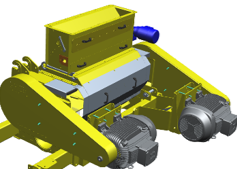
Soft rolling unit

Soft rolling unit

The grains are then continuously dosed and fed into a soft rolling unit equipped with adjustable corrugated rollers.

• Kernels are broken down into flakes or soft press, which increases surface area and ruminal accessibility for starch and proteins.
• Soft rolling of moist grain prevents excessive fines, effectively reducing digestive issues and mix segregation.

• The roller mill is integrated in-line, with feed rates accurately matched to upstream and downstream capacities to ensure consistent flake density.

Phase 4: Continuous solid dosing and mixing

  • The continuous dosing architecture merges multiple solid streams, including flakes, pellets, mash, and expanded products.
  • Gravimetric belt PLP model ENSP and gravimetric screw feeders SCF models maintain strict formulation
    ratios under continuous mass flow control

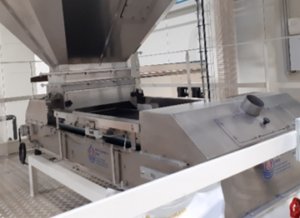
    PLP Systems gravimetric feeder ENSP

    PLP Systems gravimetric feeder ENSP

  • Continuous mixing by the MT50 unit, ensures high throughput with zero downtime for filling and emptying mixers.
  • Steady-state operation effectively reduces batch-to-batch variations, resulting in greater consistency over long runs.
  • Automated feeding minimizes human error, resulting in improved composition fidelity alongside lower labor and energy costs.

Phase 5: Liquid coating with oils and molasses

In the same stage of mixing the muesli by the MT50 unit, liquids are uniformly applied.

  • Vegetable oils are sprayed, depending on the formulation request
  • Molasses is applied with a range from 0.5% to 5%, depending on the formula.
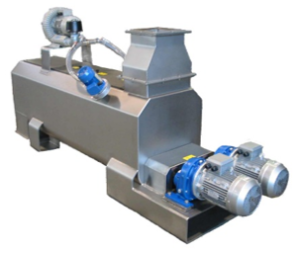
  • Continuous mixer and coater MT50

    Continuous mixer and coater MT50

    Oils and molasses are nebulized using SMOG PLP SPRAYING technology, ensuring a fine nebulization even with viscous liquids.

  • Liquid enzymes are added on request
  • This allows high inclusion of liquids, which increases the feed’s overall energy density.
  • Liquid coating improves dust control because the liquid film binds fines to larger particles.
  • The added molasses and oils significantly enhance feed palatability and intake.
  • PPLA of the enzyme and heat sensitive ingredients, helps reducing the used quantity.

Nutritional and operational benefits

  • Improved starch digestibility: Acid-water conditioning and soft rolling enhance starch availability and overall digestibility by 8-15% compared to whole grain.
  • Optimal rumen health: The balanced mechanical structure of flakes, pellets, mash, and expanded products promotes proper chewing, rumination, and overall digestive stability.
  • Enhanced operational efficiency: Continuous processing eliminates start–stop transients, resulting in superior product homogeneity, higher throughput within a compact plant footprint, and expanded formulation flexibility.
  • Hygienic system design: Engineering focuses on a clean layout and minimal product retention zones, supporting strict feed hygiene and biosecurity standards.
  • Energy and resource savings: Steady-state continuous processing significantly reduces specific energy consumption and idle downtime compared to conventional batch systems.
  • Advanced automation: Continuous dosing and mixing integrate directly with real-time process control platforms, offering continuous monitoring of mass flow rates, feed composition, and equipment operational status.

Why choose a continuous PLP Systems plant

For a feed mill or livestock operation looking to scale production while maintaining consistent quality, a continuous muesli feed plant is a strategic investment: less variability, less waste, greater formulation flexibility and a final product with stronger nutritional performance.

If you’re evaluating how to modernize your feed production line or want more technical information about the plant, contact PLP Systems for a personalized consultation.

PLP Systems specializes in both liquids and powders, with a special focus on the pet food and feed industries. An important area for PLP is the accurate and precise handling of liquids and powder for pet food and feed production, with a specific focus on post-pellet coating and kibble palatability enhancing.

This process involves adding micro-liquids such as enzymes, vitamins, flavors, probiotics amd yeast to the pellets, aiming to enhance their quality and oils, digest and palatants to kibbles.

Whether you’re looking to improve your current production line or explore innovative methods to increase product appeal, our technologies offer the reliability and excellence you need.

Need more information or want to dive deeper into our systems?

We’re here to provide tailored solutions and answer all your questions.

Call us today at +39 0523 891 629 or email us at info@plp-systems.com for a free consultation.
We’re here to help you find the perfect solution for your needs!

Share this article
  • Share on Facebook
  • Share on X
  • Share on WhatsApp
  • Share on Pinterest
  • Share on LinkedIn
  • Share by Mail

Recent news

  • PLP Systems at Cibus Tec 2026 12 October 2026
  • Continuous muesli Feed Plant | Ruminant nutrition solutions 26 August 2026
  • PLP Systems at CIPAL 2026: Precision solutions for Pet Food manufacturers 21 August 2026
  • POST PELLET COATING 19 June 2026
  • COME JOIN US AT INTERZOO NUREMBERG – STAND 4A-421 4 May 2026

Archives

  • October 2026
  • August 2026
  • June 2026
  • May 2026
  • March 2026
  • February 2026
  • October 2025
  • September 2025
  • August 2025
  • July 2025
  • May 2025
  • April 2025
  • March 2025
  • February 2025
  • December 2024
  • October 2024
  • September 2024
  • August 2024
  • June 2024
  • May 2024
  • April 2024
  • March 2024
  • November 2023
  • October 2023
  • August 2023
  • June 2023
  • January 2023
  • September 2022
  • May 2022
  • October 2021
  • September 2021
  • April 2021
  • February 2021
  • September 2020
  • July 2020
  • June 2020
  • January 2020
  • November 2019
  • October 2019
  • September 2019
  • June 2019
  • May 2019
  • April 2019

Categories

  • Curiosities
  • Fair
  • News
  • Technical articles
  • Technical articles
  • Uncategorized

PLP Systems SRL

Strada Provinciale 21, N° 303
29018 Lugagnano Val d’Arda
Piacenza, Italy
P.IVA 01373620333

T. +39.0523.891629
E. info@plp-systems.com

HOME
COMPANY
SECTORS
SYSTEMS & MACHINERY
PLP WORLDWIDE
NEWS
CONTACTS

PLP© Copyright 2019 | Privacy Policy | Cookie Policy |
Link to: PLP Systems at CIPAL 2026: Precision solutions for Pet Food manufacturers Link to: PLP Systems at CIPAL 2026: Precision solutions for Pet Food manufacturers PLP Systems at CIPAL 2026: Precision solutions for Pet Food manufacturersLink to: PLP Systems at Cibus Tec 2026 Link to: PLP Systems at Cibus Tec 2026 PLP Systems at Cibus Tec 2026
Scroll to top Scroll to top Scroll to top